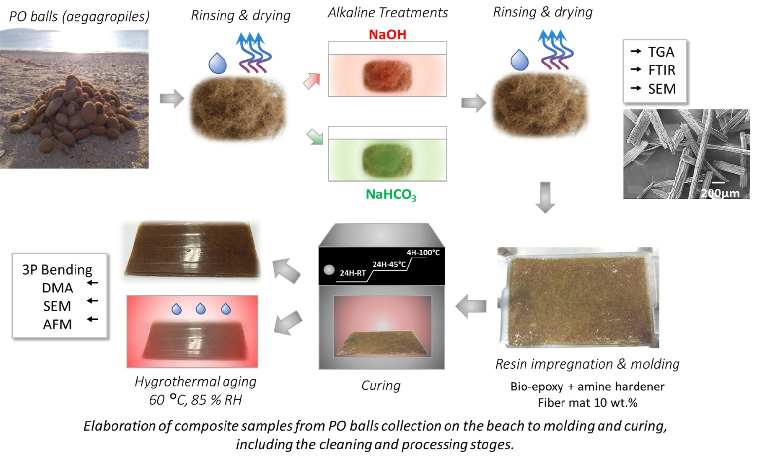

The valorization of the abundant marine residue Posidonia oceanica (PO) fibers, as a filler in a bio-based epoxy matrix was investigated. Raw PO fibers collected from seasonal beach deposits, were subjected to
different alkali treatments to remove extractives and improve fiber–matrix adhesion. Treated or untreated (UT) fiber mats were dried, impregnated with bio-based epoxy resin, and cured. The effects of these treatments were characterized using thermogravimetric analysis, infrared spectroscopy, scanning electron microscopy (SEM), and atomic force microscopy (AFM). NaOH treatment induced the most significant changes in thermal behavior and surface chemistry, while NaHCO3 treatment had intermediate effects. However, these modifications were less pronounced than those typically observed in terrestrial plant fibers. SEM observations and nanomechanical characterization by AFM revealed good interfacial cohesion in all composites regardless of treatment. Fiber addition increased the flexural modulus at low fiber contents and influenced the viscoelastic behavior and molecular mobility of the composites. Water uptake was also evaluated and was strongly influenced by fiber treatment. Overall, conventional alkali treatments proved too aggressive for PO fibers, suggesting that milder, environmentally friendly treatments are better suited to improving the durability and performance of green composites.
aging, bio-composites, fiber treatment, nanomechanical mapping, waste fiber